Awards Are Footnotes, Not Foundations: Anish Kanjilal Urges Writers to Chase Ideas, Not Accolades

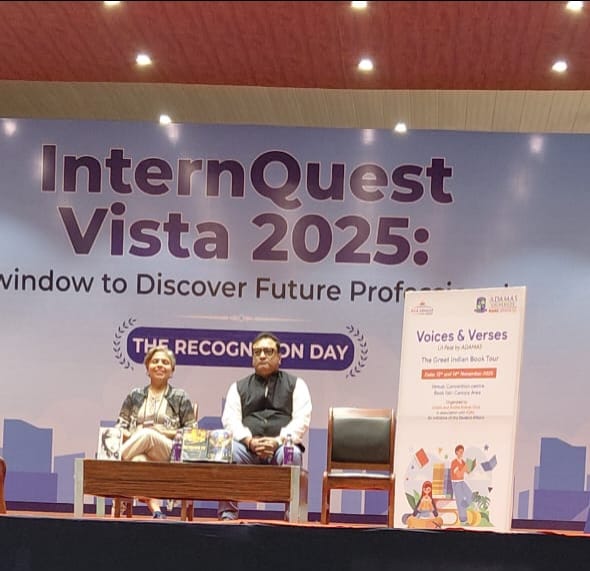
Kolkata: In an age where literary success is often measured by trophies and titles, author and educator Anish Kanjilal delivered a compelling counter-narrative during a literary panel discussion at Adamas University, arguing that awards are merely milestones—not the measure of a writer’s greatness.
Speaking before students, academics and literature enthusiasts, Kanjilal challenged the growing culture of equating artistic merit with institutional recognition. The celebrated author, known for Fateless 13 and 11 Oracles, drew upon literary history, philosophy and personal experience to make a powerful case for valuing ideas over accolades.
Ironically, the speaker himself is no stranger to recognition. A recipient of the Rajasthan Patrika Literary Award (2009), the National Education Forum’s Best Educator Award (2024) and the Best Poet Award at the Kolkata Literary Carnival (2025), Kanjilal used his own journey to emphasise that awards may honour achievement, but they do not create it.
A crown does not make a king, and a genius blooms in silence, he remarked, setting the tone for a session that repeatedly questioned conventional definitions of literary success.
Literary Icons Who Refused Recognition
Tracing the relationship between creativity and recognition, Kanjilal cited examples of celebrated writers who remained indifferent—or even hostile—to prestigious honours.
He spoke about George Bernard Shaw, the only person to have received both the Nobel Prize in Literature and an Academy Award. Shaw, Kanjilal noted, famously criticised the Nobel Prize, describing it as an unnecessary honour, and later showed little enthusiasm for collecting his Oscar. The anecdote, he said, illustrated that genuine artists often place their work above ceremonial recognition.
The discussion then turned to Jean-Paul Sartre, who declined the Nobel Prize in Literature because he did not wish to become “institutionalised” or be defined by official recognition.
According to Kanjilal, these decisions were reminders that a writer’s enduring legacy lies not in medals but in intellectual independence and originality.
Beyond the Nobel: Tagore’s Legacy
Drawing closer to home, Kanjilal reflected on Rabindranath Tagore, whose Gitanjali gained international prominence through the efforts of artist William Rothenstein and poet W.B. Yeats before eventually earning the Nobel Prize.
While acknowledging the historical significance of Tagore’s Nobel, Kanjilal argued that the Bengali polymath’s literary stature would have remained undiminished even without the honour.
Great literature survives because readers continue to discover it—not because juries once recognised it, he observed.
Shakespeare’s Greatest Award: Time
Kanjilal also highlighted William Shakespeare, pointing out that the playwright lived in an era without formal literary awards, yet became one of history’s most influential writers.
He noted that Shakespeare explored complex psychological states—including guilt, paranoia and psychosis—through characters such as Macbeth and Hamlet centuries before psychology emerged as an academic discipline.
Shakespeare didn’t need trophies,” Kanjilal said. “His readers became his legacy.
Questioning Institutional Bias
The session also examined how contemporary awards can be shaped by geography and institutional frameworks.
Kanjilal pointed out that certain prestigious honours remain limited by nationality or region, citing examples such as the Pulitzer Prize, which is largely restricted to American authors and journalists, and literary awards with regional eligibility criteria.
Such restrictions, he argued, inevitably exclude many deserving voices and narrow the scope of global literary recognition.
Adding a lighter note, he remarked that some organisations appear to organise literary competitions only to reward themselves—drawing laughter from the audience.
Recognition Often Arrives Too Late
To reinforce his argument, Kanjilal referred to H.P. Lovecraft, whose pioneering contribution to cosmic horror received little appreciation during his lifetime. The author’s influence, he noted, expanded dramatically only after his death, illustrating how genuine literary innovation is often recognised long after its creator is gone.
A Curriculum for the Present
Moving beyond awards, Kanjilal urged educational institutions to broaden literary curricula by incorporating more contemporary writers alongside established classics.
While reaffirming the importance of canonical literature, he argued that students should also engage with voices that reflect the anxieties, aspirations and realities of the twenty-first century.
According to him, literature remains relevant only when each generation is allowed to hear its own stories alongside those that have shaped the past.
Ideas Outlive Medals
Concluding the session, Kanjilal returned to the central message of his address.
Awards can encourage, but they cannot define. A writer lives through their ideas, their characters, their stories—not through the medals they collect.
His remarks received an enthusiastic response from the audience, offering a thoughtful reminder that while honours may acknowledge achievement, it is ultimately the enduring relationship between a writer and readers that determines literary immortality.
In a cultural climate increasingly driven by rankings, prizes and public validation, Kanjilal’s address served as a timely affirmation that the most enduring legacy of any author is not a shelf of trophies, but the ideas that continue to inspire generations.

Reporting for Hindustan Hunt on news and stories from across India.