
The Growing Challenges of Marketplace Accounting and How Technology Can Help Sellers

Introduction
The growth of online marketplaces has changed how businesses sell products in India. Small businesses, manufacturers, distributors and established brands can now reach customers across the country through platforms such as Amazon, Flipkart, Meesho, Myntra and other e-commerce channels.
While these platforms create new business opportunities, they also introduce additional accounting responsibilities.
Every marketplace transaction generates financial information that needs to be recorded, checked and reconciled. Sellers must manage sales, returns, refunds, commissions, shipping charges, taxes and settlement adjustments while maintaining accurate accounting records.
As businesses expand across multiple marketplaces, managing these activities manually can become increasingly difficult.
Technology and e-commerce accounting automation can help businesses organise these processes and reduce repetitive accounting work.
1. Multiple Marketplaces Create Multiple Accounting Challenges
Many online sellers no longer depend on a single marketplace. A business may sell products through Amazon, Flipkart, Meesho and its own website simultaneously.
Each platform provides different reports, transaction details and settlement information.
For accounting teams, this means handling multiple data sources and preparing the information for financial reporting.
Some common challenges include:
- Downloading and organising reports from different marketplaces.
- Managing different report formats and column structures.
- Recording marketplace sales and related charges.
- Processing customer returns and refunds.
- Identifying settlement deductions.
- Reconciling marketplace payments with bank credits.
- Preparing GST-related accounting information.
Without an organised workflow, these activities can consume significant time and increase the complexity of daily accounting operations.
2. Settlement Reconciliation Becomes More Difficult as Sales Grow
Marketplace settlement reconciliation is an important part of e-commerce accounting.
The amount deposited into a seller’s bank account may not equal the total sales recorded during the same period.
This is because marketplace settlements can include deductions and adjustments such as:
- Marketplace commissions.
- Shipping and fulfilment charges.
- Other marketplace service fees.
- Customer refunds and returns.
- GST on applicable marketplace services.
- GST TCS and applicable income-tax TDS.
- Other settlement adjustments.
Sellers need to understand how these amounts affect the final payment received from the marketplace.
When transaction volumes increase, manually matching sales reports, settlement reports and bank deposits becomes more challenging.
A structured reconciliation process helps businesses maintain better visibility into their sales, deductions and actual receipts.
3. GST Accounting Requires Proper Transaction Records
E-commerce sellers also need to maintain appropriate GST-related accounting information.
This involves more than recording the total value of orders.
Businesses may need to review:
Sales and Taxable Values: Recording sales with appropriate transaction details and applicable GST treatment.
Returns and Credit Notes: Accounting for returned goods, refunds and applicable adjustments.
Marketplace Charges: Recording commissions, fulfilment charges and other marketplace services, including applicable GST.
GST TCS: Reconciling applicable tax collected at source by e-commerce operators.
Income-tax TDS: Reviewing applicable deductions under Section 194-O against relevant tax records.
Maintaining organised records helps sellers and accounting professionals review their financial information and support compliance-related activities.
4. Why Multiple Excel Files and Manual Processes Become Difficult to Maintain
Excel is widely used by marketplace sellers and accountants because it provides flexibility for managing financial information.
Many businesses use formulas, VBA macros and separate spreadsheets to process marketplace reports.
These tools can be useful, especially when transaction volumes are limited. However, as operations expand, maintaining multiple disconnected tools can create additional work.
Some common problems include:
- Separate Excel macros for different marketplaces.
- Changes in marketplace report formats.
- Repeated manual data filtering.
- Maintaining multiple versions of accounting files.
- Difficulty tracking transaction-level differences.
- Additional time required for validation and error checking.
Instead of spending time maintaining separate processes, businesses can explore a more unified approach to marketplace report processing.
5. How Technology Can Simplify Marketplace Accounting
Technology can help businesses organise accounting operations by reducing repetitive data preparation and connecting marketplace information with accounting workflows.
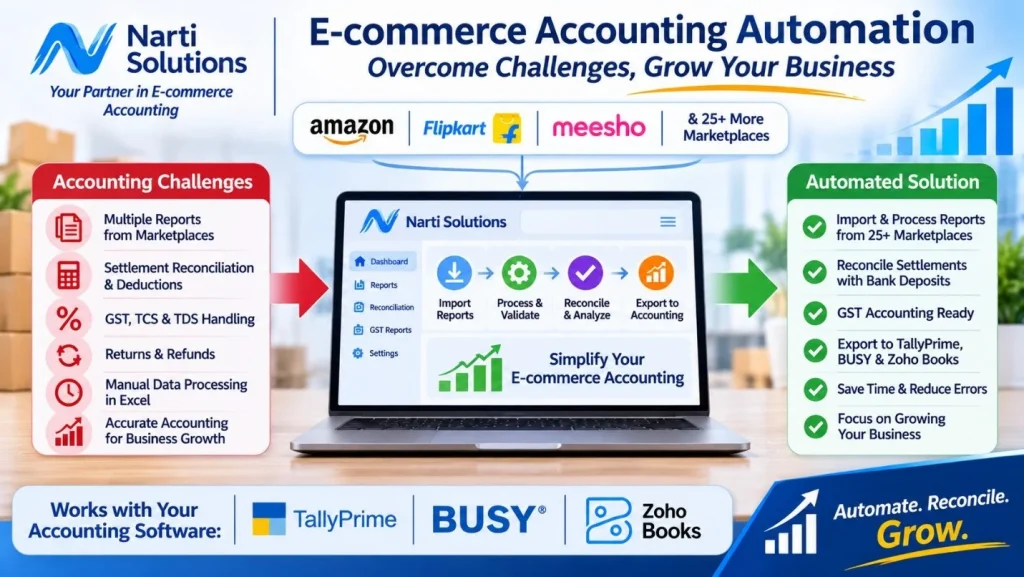
A suitable e-commerce accounting automation solution should help users:
- Process reports from supported marketplaces.
- Organise sales and transaction information.
- Identify potential inconsistencies through validation checks.
- Prepare settlement and accounting information.
- Support accounting software integration.
- Reduce repetitive manual preparation.
The objective is not simply to automate data entry. It is to create a more structured process from marketplace report collection to accounting record preparation.
6. Narti Solutions: Bringing Marketplace Accounting Workflows Together
Narti Solutions focuses on developing software and automation solutions for marketplace report processing, reconciliation, data validation and accounting integration.
The platform is designed for marketplace sellers, accountants, bookkeepers and CA firms who need to manage financial information from different e-commerce platforms.
Narti Solutions is designed to support more than 25 e-commerce platform configurations, subject to the availability of supported report formats and workflows.
It also provides accounting workflows for users working with supported configurations of:
- TallyPrime.
- BUSY.
- Zoho Books.
This approach allows businesses to explore marketplace accounting automation while continuing to use their existing accounting software.
7. How the Narti Solutions Workflow Works
The process can be divided into four main stages.
Step 1: Import Marketplace Reports
Users import the required reports from supported e-commerce platforms.
These reports may include orders, sales, marketplace fees, returns, refunds and settlement information.
Step 2: Process and Validate Data
The system processes the imported information and applies relevant validation checks.
AI-assisted data processing can support filtering, organising and identifying potential inconsistencies for further review.
Step 3: Prepare Accounting-Ready Information
After processing and review, the information is organised according to the requirements of the selected accounting workflow.
Step 4: Export to Accounting Software
Users can prepare the processed information for supported accounting workflows involving TallyPrime, BUSY and Zoho Books.
The specific export format and integration process depend on the accounting application and supported configuration.
8. How AI-Assisted Processing Can Support Accounting Teams
Artificial intelligence is creating new opportunities to organise and process business data.
In marketplace accounting, AI-assisted processing can help with:
- Filtering and organising report information.
- Identifying potential data inconsistencies.
- Supporting repetitive data preparation.
- Organising transaction information for review.
- Preparing information for accounting workflows.
AI should be used alongside validation rules and human review. Financial information, tax treatment and accounting entries still require appropriate verification.
The goal is to help accounting professionals spend less time on repetitive preparation and more time reviewing important financial information.
9. Who Can Benefit from E-commerce Accounting Automation?
Individual Marketplace Sellers
Businesses selling through multiple marketplaces can benefit from more organised sales, fee and settlement processing.
Growing E-commerce Businesses
Companies experiencing higher transaction volumes can explore automation instead of depending entirely on manual spreadsheets.
Accountants and Bookkeepers
Professionals handling marketplace accounting can use structured workflows to prepare accounting information.
Chartered Accountant Firms
CA firms managing multiple e-commerce clients can explore a centralised approach to processing marketplace reports.
Businesses Using Different Accounting Applications
Companies using TallyPrime, BUSY or Zoho Books can explore supported marketplace accounting workflows without necessarily replacing their existing accounting software.
10. Building More Efficient Accounting Operations
Marketplace accounting is becoming an important operational function for growing online businesses.
As transaction volumes increase, sellers need reliable processes for managing sales reports, marketplace deductions, returns, GST information and payment settlements.
Using disconnected spreadsheets and manual workflows can make these responsibilities increasingly difficult to manage.
E-commerce accounting automation offers a way to organise these activities and support more consistent financial record preparation.
Through its focus on marketplace report processing, validation, reconciliation and accounting integration, Narti Solutions aims to help Indian marketplace sellers and accounting professionals simplify these operations.
Businesses interested in exploring the platform can visit:
Website: https://nartisolutions.com/
Visitors can explore the available solutions and enquire about a demonstration based on their marketplace and accounting software requirements.
About Narti Solutions
Narti Solutions develops software and automation solutions focused on e-commerce accounting, marketplace report processing, settlement reconciliation and accounting integration. Its solutions are designed for marketplace sellers, accountants, bookkeepers and CA firms working with supported e-commerce platforms and accounting applications, including TallyPrime, BUSY and Zoho Books.

Reporting for Hindustan Hunt on news and stories from across India.